Guide
Faktwise Quick Start: From Install to Your First E-Invoice
Updated 2026-07-02
Faktwise turns paid Shopify orders into e-invoices automatically: a human-readable PDF that is also a ZUGFeRD invoice, or an XRechnung when a public authority is buying. Getting there takes a handful of short steps: install the app, save your company details, add the cart field for business customers, and run one test order. This guide walks you through each step in order, from installation to your first finished invoice. You do not need an accounting background, just access to your Shopify admin.
Step 1: Install Faktwise from the Shopify App Store
Open Faktwise on the Shopify App Store and install the app. Shopify asks once for the required permissions, and afterwards you will find Faktwise among your apps in the Shopify admin. The Free plan includes 5 invoices per month, which is plenty for a first test run. The Unlimited plan is EUR 19 per month (billed through Shopify, where it shows as about USD 22) and comes with a 14-day trial.
Step 2: Enter your company details in Settings
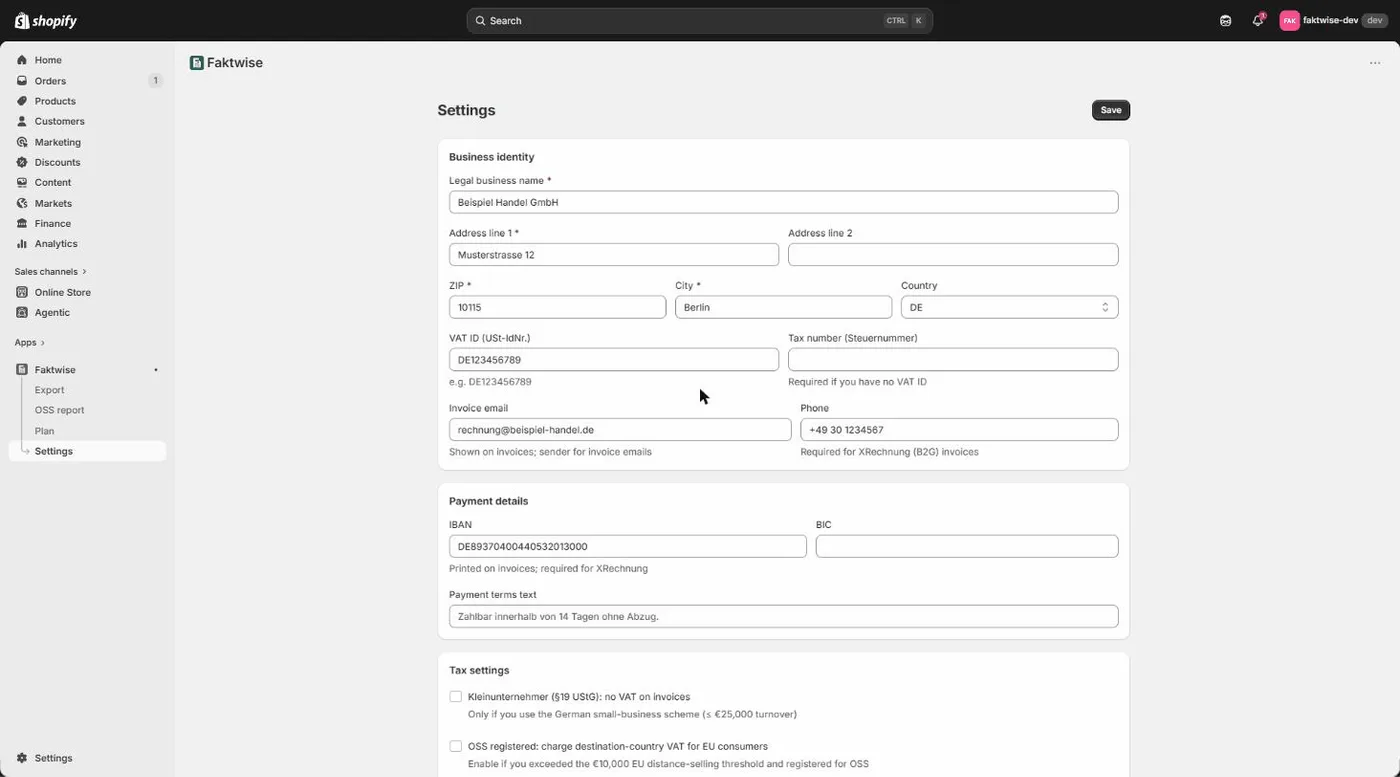
Open Settings inside the app. This is where you enter the details that have to appear on every invoice. The reason is § 14 UStG, the section of the German VAT Act that lists the mandatory contents of an invoice. If one of them is missing, the invoice is formally incomplete.
The required fields:
- Legal name: the official name of your business, because § 14 requires the full name of the supplier.
- Address, ZIP, city and country: your complete business address, also mandatory.
- USt-IdNr. or Steuernummer: one of the two is enough. The USt-IdNr. is your EU-wide VAT ID, the Steuernummer is the number your German tax office assigned to you.
Optional, but worth filling in right away:
- Contact email and IBAN (plus BIC): these unlock XRechnung for public-sector orders. The XRechnung standard requires the seller’s contact and payment details; if they are missing, an order with a Leitweg-ID is issued as a ZUGFeRD invoice instead, and the dashboard shows a notice.
- A phone number and a payment terms text.
You will also see a few switches: Kleinunternehmer for merchants under § 19 UStG (the German small business scheme; such invoices show no VAT at all), OSS for the EU One Stop Shop scheme (it lets you report VAT on B2C sales to other EU countries centrally; switch it on only if you actually take part in OSS), a default for whether you mainly sell goods or services, the invoice language (German or English), and the automatic invoice email. Automatic invoicing on paid orders is switched on by default. The invoice settings guide explains every field and switch in detail.
Important: nothing is generated until you save
Until you save the settings for the first time, Faktwise creates no invoices at all. Paid orders arriving before that first save are skipped silently. This is deliberate: an invoice without your company details would be incomplete. The first save completes the setup, and from that moment on every paid order is invoiced automatically.
Step 3: Add the cart field for VAT IDs and Leitweg-IDs
If you sell to business or public-sector customers, this extra step is worth it. The Faktwise cart field is a theme app block you set up once: go to Online Store > Themes > Customize (the Settings page in Faktwise has a card that deep-links you straight into the theme editor), switch to the cart template, add the Faktwise VAT / Leitweg-ID section from the Apps group, and save. In your storefront the field stays collapsed behind a business customer toggle; the buyer expands it and enters a VAT ID and/or a Leitweg-ID. A Leitweg-ID is the routing code German public authorities use to direct e-invoices to the right recipient; when an order carries one, Faktwise issues an XRechnung. An EU VAT ID is checked live against VIES, the EU’s VAT number verification system, at invoice time; if VIES is unreachable, VAT is charged as the cautious default. The block works on every Shopify plan because it lives on the cart page, not in checkout, where custom fields are a Shopify Plus feature. The cart field guide walks through this step by step.
Step 4: Place a test order and pay it
Place an order in your own store and complete the payment. Faktwise reacts to the payment, not to the order itself: the invoice is created when Shopify reports the order as paid. A tip: fully refund the test order afterwards and you will also see how corrections work, because a refund in Shopify automatically creates a credit note that references the original invoice.
Step 5: Look at your first invoice on the dashboard
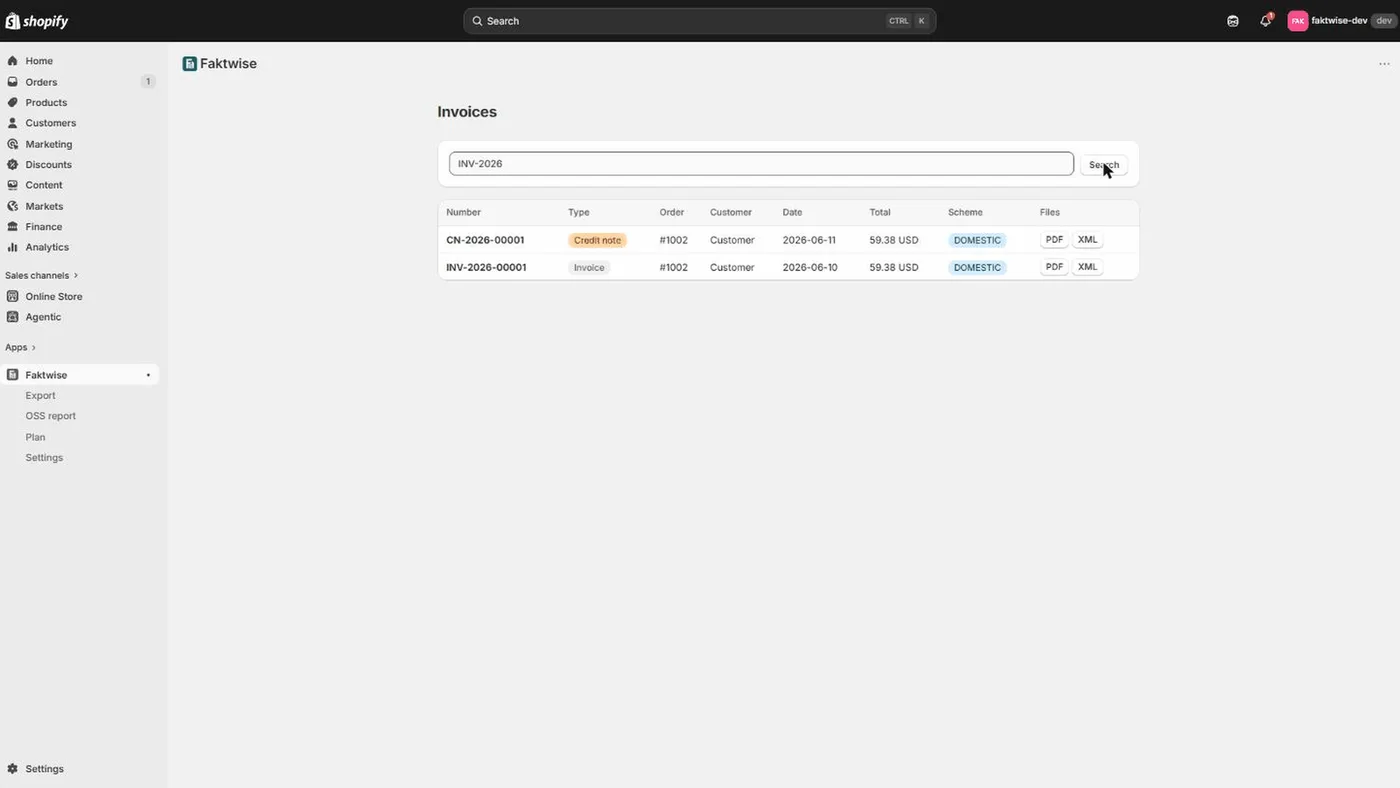
Open the Faktwise dashboard. Your invoice sits at the top of the list (newest first, searchable by invoice number or order). Each row offers two downloads: the PDF for people and the XML for machines. The PDF is more than a plain document: it is a ZUGFeRD invoice, a PDF/A-3 file with the machine-readable XML embedded according to EN 16931, the European norm that standardizes what an e-invoice contains. Take a minute with this first invoice: are the company details, amounts and VAT treatment right? For a second opinion, drop the file into our free invoice validator: it checks XRechnung XML with the official KoSIT validator and ZUGFeRD PDFs with Mustang, including the PDF/A check.
What happens on every future paid order
From now on, invoicing runs in the background while you sell:
- Automatic invoice: every paid order gets a PDF with the embedded ZUGFeRD XML; an order with a Leitweg-ID gets an XRechnung instead (provided your contact email and IBAN are set).
- The right VAT scheme: Faktwise applies one of six schemes automatically: German domestic sales at 19 percent (with the reduced 7 percent rate per line when the Shopify order data marks a line as reduced), reverse charge for EU cross-border B2B services (the VAT liability shifts to the buyer; purely domestic German § 13b cases are not covered), intra-community supplies for EU cross-border B2B goods, OSS for B2C sales to other EU countries at the destination country’s standard rate (only once you have switched OSS on), tax-free exports outside the EU, and the Kleinunternehmer scheme with no VAT shown. The correct legal wording is printed on the invoice automatically.
- Gap-free numbering: invoice numbers run sequentially per year, for example INV-2026-00042, and a failed generation never burns a number.
- Corrections via credit note: an issued invoice is never edited afterwards. A refund in Shopify automatically creates a credit note referencing the original invoice.
- Archive: every invoice (PDF and XML) is stored for ten years, beyond the statutory eight-year retention period that applies since 2025. The archive is designed for the GoBD requirements, the German tax authority’s rules for keeping digital records: invoices are stored so they are not changed after issue, corrections happen only through credit notes, and personal data is encrypted at rest. The GoBD archiving guide has the details.
- Optional email: Faktwise can email the invoice PDF to your customer as soon as the order is paid. This is off by default; enable it in Settings and pick the German or English template.
That is the whole quick start: install, save your company details, add the cart field, run one test order. If you would like to see the flow before installing anything, have a look at the demo. Faktwise is software, not tax advice. For questions about your own tax situation, for example whether OSS or the small business scheme applies to you, your tax advisor is the right person to ask. Ready when you are: install Faktwise from the Shopify App Store and let your first e-invoice create itself.